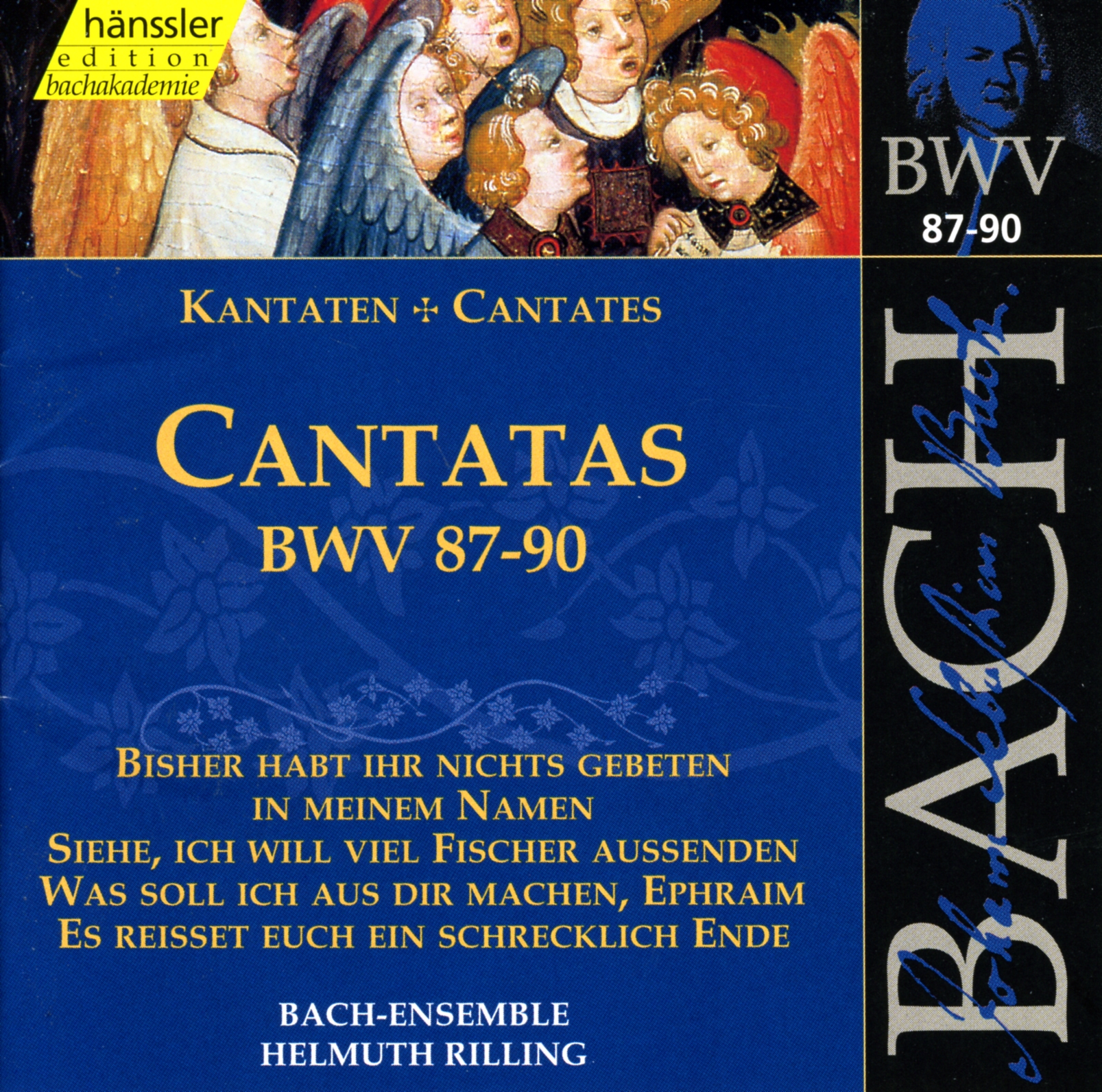
Cantatas, BWV 87–90

~ Uitgave van Johann Sebastian Bach; Bach‐Collegium Stuttgart, Helmuth Rilling (Bekijk alle versies van deze uitgave, 2 beschikbaar)

Nummerlijst

1digitale media
#TitelArtiestWaarderingDuur
1Kantate, BWV 87 “Bisher habt ihr nichts gebeten in meinem Namen”: I. Arioso (Bass) “Bisher habt ihr nichts gebeten in meinem Namen”
basvocalen:
Walter Heldwein
orkest:
Bach‐Collegium Stuttgart (German baroque ensemble led by Helmuth Rilling, aka Bach‐Ensemble)
was dirigent:
Helmuth Rilling (conductor)
opgenomen bij:
Gedächtniskirche Stuttgart in Stuttgart, Baden-Württemberg, Duitsland (van 1980-12 tot 1981-03)
is een opname van:
Kantate, BWV 87 "Bisher habt ihr nichts gebeten in meinem Namen": I. Arioso (Bass) "Bisher habt ihr nichts gebeten in meinem Namen" (van 1980-12 tot 1981-03)
componist:
Johann Sebastian Bach (German Baroque period composer & musician) (in 1725)
deel van:
Kantate, BWV 87 "Bisher habt ihr nichts gebeten in meinem Namen"
Johann Sebastian Bach2:12
2Kantate, BWV 87 “Bisher habt ihr nichts gebeten in meinem Namen”: II. Recitativo (Alt) “O Wort, das Geist und Seel erschreckt”
altvocalen:
Júlia Hamari (Hungarian mezzo-soprano)
orkest:
Bach‐Collegium Stuttgart (German baroque ensemble led by Helmuth Rilling, aka Bach‐Ensemble)
was dirigent:
Helmuth Rilling (conductor)
opgenomen bij:
Gedächtniskirche Stuttgart in Stuttgart, Baden-Württemberg, Duitsland (van 1980-12 tot 1981-03)
is een opname van:
Kantate, BWV 87 "Bisher habt ihr nichts gebeten in meinem Namen": II. Recitativo (Alt) "O Wort, das Geist und Seel erschreckt" (van 1980-12 tot 1981-03)
componist:
Johann Sebastian Bach (German Baroque period composer & musician) (in 1725)
deel van:
Kantate, BWV 87 "Bisher habt ihr nichts gebeten in meinem Namen"
Johann Sebastian Bach0:48
3Kantate, BWV 87 “Bisher habt ihr nichts gebeten in meinem Namen”: III. Aria (Alt) “Vergib, o Vater, unsre Schuld”
altvocalen:
Júlia Hamari (Hungarian mezzo-soprano)
orkest:
Bach‐Collegium Stuttgart (German baroque ensemble led by Helmuth Rilling, aka Bach‐Ensemble)
was dirigent:
Helmuth Rilling (conductor)
opgenomen bij:
Gedächtniskirche Stuttgart in Stuttgart, Baden-Württemberg, Duitsland (van 1980-12 tot 1981-03)
is een opname van:
Kantate, BWV 87 "Bisher habt ihr nichts gebeten in meinem Namen": III. Aria (Alt) "Vergib, o Vater, unsre Schuld" (van 1980-12 tot 1981-03)
componist:
Johann Sebastian Bach (German Baroque period composer & musician) (in 1725)
deel van:
Kantate, BWV 87 "Bisher habt ihr nichts gebeten in meinem Namen"
Johann Sebastian Bach8:43
4Kantate, BWV 87 “Bisher habt ihr nichts gebeten in meinem Namen”: IV. Recitativo (Tenor) “Wenn unsre Schuld bis an den Himmel steigt”
tenorvocalen:
Aldo Baldin (tenor)
orkest:
Bach‐Collegium Stuttgart (German baroque ensemble led by Helmuth Rilling, aka Bach‐Ensemble)
was dirigent:
Helmuth Rilling (conductor)
opgenomen bij:
Gedächtniskirche Stuttgart in Stuttgart, Baden-Württemberg, Duitsland (van 1980-12 tot 1981-03)
is een opname van:
Kantate, BWV 87 "Bisher habt ihr nichts gebeten in meinem Namen": IV. Recitativo (Tenor) "Wenn unsre Schuld bis an den Himmel steigt" (van 1980-12 tot 1981-03)
componist:
Johann Sebastian Bach (German Baroque period composer & musician) (in 1725)
deel van:
Kantate, BWV 87 "Bisher habt ihr nichts gebeten in meinem Namen"
Johann Sebastian Bach1:01
5Kantate, BWV 87 “Bisher habt ihr nichts gebeten in meinem Namen”: V. Arioso (Bass) “In der Welt habt ihr Angst”
basvocalen:
Walter Heldwein
orkest:
Bach‐Collegium Stuttgart (German baroque ensemble led by Helmuth Rilling, aka Bach‐Ensemble)
was dirigent:
Helmuth Rilling (conductor)
opgenomen bij:
Gedächtniskirche Stuttgart in Stuttgart, Baden-Württemberg, Duitsland (van 1980-12 tot 1981-03)
is een opname van:
Kantate, BWV 87 "Bisher habt ihr nichts gebeten in meinem Namen": V. Arioso (Bass) "In der Welt habt ihr Angst" (van 1980-12 tot 1981-03)
componist:
Johann Sebastian Bach (German Baroque period composer & musician) (in 1725)
deel van:
Kantate, BWV 87 "Bisher habt ihr nichts gebeten in meinem Namen"
Johann Sebastian Bach2:11
6Kantate, BWV 87 “Bisher habt ihr nichts gebeten in meinem Namen”: VI. Aria (Tenor) “Ich will leiden, ich will schweigen”
tenorvocalen:
Aldo Baldin (tenor)
orkest:
Bach‐Collegium Stuttgart (German baroque ensemble led by Helmuth Rilling, aka Bach‐Ensemble)
was dirigent:
Helmuth Rilling (conductor)
opgenomen bij:
Gedächtniskirche Stuttgart in Stuttgart, Baden-Württemberg, Duitsland (van 1980-12 tot 1981-03)
is een opname van:
Kantate, BWV 87 "Bisher habt ihr nichts gebeten in meinem Namen": VI. Aria (Tenor) "Ich will leiden, ich will schweigen" (van 1980-12 tot 1981-03)
componist:
Johann Sebastian Bach (German Baroque period composer & musician) (in 1725)
deel van:
Kantate, BWV 87 "Bisher habt ihr nichts gebeten in meinem Namen"
Johann Sebastian Bach3:50
7Kantate, BWV 87 “Bisher habt ihr nichts gebeten in meinem Namen”: VII. Choral “Muß ich sein betrübet”
koor:
Gächinger Kantorei Stuttgart
orkest:
Bach‐Collegium Stuttgart (German baroque ensemble led by Helmuth Rilling, aka Bach‐Ensemble)
was dirigent:
Helmuth Rilling (conductor)
opgenomen bij:
Gedächtniskirche Stuttgart in Stuttgart, Baden-Württemberg, Duitsland (van 1980-12 tot 1981-03)
is een opname van:
Kantate, BWV 87 "Bisher habt ihr nichts gebeten in meinem Namen": VII. Choral "Muß ich sein betrübet" (van 1980-12 tot 1981-03)
tekstschrijver:
Heinrich von Mühler
componist:
Johann Sebastian Bach (German Baroque period composer & musician) (in 1725)
deel van:
Breitkopf 389 Choralgesänge (nummer: 201)
deel van:
Kantate, BWV 87 "Bisher habt ihr nichts gebeten in meinem Namen"
Johann Sebastian Bach1:34
8Kantate, BWV 88 “Siehe, ich will viel Fischer aussenden”: I. Aria (Bass) “Siehe, ich will viel Fischer aussenden”
basvocalen:
Wolfgang Schöne (bass-baritone)
orkest:
Bach‐Collegium Stuttgart (German baroque ensemble led by Helmuth Rilling, aka Bach‐Ensemble)
was dirigent:
Helmuth Rilling (conductor)
opgenomen bij:
Gedächtniskirche Stuttgart in Stuttgart, Baden-Württemberg, Duitsland (van 1970-06 tot 1970-07)
is een opname van:
Kantate, BWV 88 "Siehe, ich will viel Fischer aussenden": I. Aria (Bass) "Siehe, ich will viel Fischer aussenden" (van 1970-06 tot 1970-07)
componist:
Johann Sebastian Bach (German Baroque period composer & musician) (in 1726)
deel van:
Kantate, BWV 88 "Siehe, ich will viel Fischer aussenden"
Johann Sebastian Bach7:41
9Kantate, BWV 88 “Siehe, ich will viel Fischer aussenden”: II. Recitativo (Tenor) “Wie leichtlich könnte doch der Höchste uns entbehren”
tenorvocalen:
Adalbert Kraus (tenor)
orkest:
Bach‐Collegium Stuttgart (German baroque ensemble led by Helmuth Rilling, aka Bach‐Ensemble)
was dirigent:
Helmuth Rilling (conductor)
opgenomen bij:
Gedächtniskirche Stuttgart in Stuttgart, Baden-Württemberg, Duitsland (van 1970-06 tot 1970-07)
is een opname van:
Kantate, BWV 88 "Siehe, ich will viel Fischer aussenden": II. Recitativo (Tenor) "Wie leichtlich könnte doch der Höchste uns entbehren" (van 1970-06 tot 1970-07)
componist:
Johann Sebastian Bach (German Baroque period composer & musician) (in 1726)
librettist:
[anonymous] ([anoniem], special purpose artist)
deel van:
Kantate, BWV 88 "Siehe, ich will viel Fischer aussenden"
Johann Sebastian Bach1:05
10Kantate, BWV 88 “Siehe, ich will viel Fischer aussenden”: III. Aria (Tenor), Ritornello “Nein, nein! Gott ist allezeit geflissen”
vocalen:
Adalbert Kraus (tenor)
orkest:
Bach‐Collegium Stuttgart (German baroque ensemble led by Helmuth Rilling, aka Bach‐Ensemble)
was dirigent:
Helmuth Rilling (conductor)
opgenomen bij:
Gedächtniskirche Stuttgart in Stuttgart, Baden-Württemberg, Duitsland (van 1970-06 tot 1970-07)
is een opname van:
Kantate, BWV 88 "Siehe, ich will viel Fischer aussenden": III. Aria (Tenor), Ritornello "Nein, nein! Gott ist allezeit geflissen" (van 1970-06 tot 1970-07)
componist:
Johann Sebastian Bach (German Baroque period composer & musician) (in 1726)
librettist:
[anonymous] ([anoniem], special purpose artist)
deel van:
Kantate, BWV 88 "Siehe, ich will viel Fischer aussenden"
Johann Sebastian Bach4:05
11Kantate, BWV 88 “Siehe, ich will viel Fischer aussenden”: IV. Recitativo ed Arioso (Tenor, Bass) “Jesus sprach zu Simon”
basvocalen:
Wolfgang Schöne (bass-baritone)
tenorvocalen:
Adalbert Kraus (tenor)
orkest:
Bach‐Collegium Stuttgart (German baroque ensemble led by Helmuth Rilling, aka Bach‐Ensemble)
was dirigent:
Helmuth Rilling (conductor)
opgenomen bij:
Gedächtniskirche Stuttgart in Stuttgart, Baden-Württemberg, Duitsland (van 1970-06 tot 1970-07)
is een opname van:
Kantate, BWV 88 "Siehe, ich will viel Fischer aussenden": IV. Recitativo ed Arioso (Tenor, Bass) "Jesus sprach zu Simon" (van 1970-06 tot 1970-07)
componist:
Johann Sebastian Bach (German Baroque period composer & musician) (in 1726)
deel van:
Kantate, BWV 88 "Siehe, ich will viel Fischer aussenden"
Johann Sebastian Bach2:49
12Kantate, BWV 88 “Siehe, ich will viel Fischer aussenden”: V. Aria (Duetto Sopran, Alt) “Beruft Gott selbst, so muß der Segen”
altvocalen:
Verena Gohl (Swiss contralto)
sopraanvocalen:
Ingeborg Reichelt (German soprano)
orkest:
Bach‐Collegium Stuttgart (German baroque ensemble led by Helmuth Rilling, aka Bach‐Ensemble)
was dirigent:
Helmuth Rilling (conductor)
opgenomen bij:
Gedächtniskirche Stuttgart in Stuttgart, Baden-Württemberg, Duitsland (van 1970-06 tot 1970-07)
is een opname van:
Kantate, BWV 88 "Siehe, ich will viel Fischer aussenden": V. Aria (Duetto Sopran, Alt) "Beruft Gott selbst, so muß der Segen" (van 1970-06 tot 1970-07)
componist:
Johann Sebastian Bach (German Baroque period composer & musician) (in 1726)
librettist:
[anonymous] ([anoniem], special purpose artist)
deel van:
Kantate, BWV 88 "Siehe, ich will viel Fischer aussenden"
Johann Sebastian Bach4:15
13Kantate, BWV 88 “Siehe, ich will viel Fischer aussenden”: VI. Recitativo (Sopran) “Was kann dich denn in deinem Wandel schrecken”
sopraanvocalen:
Ingeborg Reichelt (German soprano)
orkest:
Bach‐Collegium Stuttgart (German baroque ensemble led by Helmuth Rilling, aka Bach‐Ensemble)
was dirigent:
Helmuth Rilling (conductor)
opgenomen bij:
Gedächtniskirche Stuttgart in Stuttgart, Baden-Württemberg, Duitsland (van 1970-06 tot 1970-07)
is een opname van:
Kantate, BWV 88 "Siehe, ich will viel Fischer aussenden": VI. Recitativo (Sopran) "Was kann dich denn in deinem Wandel schrecken" (van 1970-06 tot 1970-07)
componist:
Johann Sebastian Bach (German Baroque period composer & musician) (in 1726)
librettist:
[anonymous] ([anoniem], special purpose artist)
deel van:
Kantate, BWV 88 "Siehe, ich will viel Fischer aussenden"
Johann Sebastian Bach1:42
14Kantate, BWV 88 “Siehe, ich will viel Fischer aussenden”: VII. Choral “Sing, bet und geh auf Gottes Wegen”
koor:
Figuralchor der Gedächtniskirche Stuttgart
orkest:
Bach‐Collegium Stuttgart (German baroque ensemble led by Helmuth Rilling, aka Bach‐Ensemble)
was dirigent:
Helmuth Rilling (conductor)
opgenomen bij:
Gedächtniskirche Stuttgart in Stuttgart, Baden-Württemberg, Duitsland (van 1970-06 tot 1970-07)
is een opname van:
Kantate, BWV 88 "Siehe, ich will viel Fischer aussenden": VII. Choral "Sing, bet und geh auf Gottes Wegen" (van 1970-06 tot 1970-07)
componist:
Johann Sebastian Bach (German Baroque period composer & musician) (in 1726)
librettist:
Georg Neumark (German hymn writer) (in 1657)
deel van:
Breitkopf 389 Choralgesänge (nummer: 368)
deel van:
Kantate, BWV 88 "Siehe, ich will viel Fischer aussenden"
Johann Sebastian Bach1:00
15Kantate, BWV 89 “Was soll ich aus dir machen, Ephraim?”: I. Aria (Bass) “Was soll ich aus dir machen, Ephraim?”
basvocalen:
Philippe Huttenlocher (baritone)
orkest:
Bach‐Collegium Stuttgart (German baroque ensemble led by Helmuth Rilling, aka Bach‐Ensemble)
was dirigent:
Helmuth Rilling (conductor)
opgenomen bij:
Gedächtniskirche Stuttgart in Stuttgart, Baden-Württemberg, Duitsland (van 1977-09 tot 1977-12)
is een opname van:
Kantate, BWV 89 "Was soll ich aus dir machen, Ephraim?": I. Aria (Bass) "Was soll ich aus dir machen, Ephraim?" (van 1977-09 tot 1977-12)
componist:
Johann Sebastian Bach (German Baroque period composer & musician) (in 1723)
deel van:
Kantate, BWV 89 "Was soll ich aus dir machen, Ephraim?"
Johann Sebastian Bach3:35
16Kantate, BWV 89 “Was soll ich aus dir machen, Ephraim?”: II. Recitativo (Alt) “Ja, freilich sollte Gott”
altvocalen:
Helen Watts (contralto)
orkest:
Bach‐Collegium Stuttgart (German baroque ensemble led by Helmuth Rilling, aka Bach‐Ensemble)
was dirigent:
Helmuth Rilling (conductor)
opgenomen bij:
Gedächtniskirche Stuttgart in Stuttgart, Baden-Württemberg, Duitsland (van 1977-09 tot 1977-12)
is een opname van:
Kantate, BWV 89 "Was soll ich aus dir machen, Ephraim?": II. Recitativo (Alt) "Ja, freilich sollte Gott" (van 1977-09 tot 1977-12)
componist:
Johann Sebastian Bach (German Baroque period composer & musician) (in 1723)
deel van:
Kantate, BWV 89 "Was soll ich aus dir machen, Ephraim?"
Johann Sebastian Bach0:59
17Kantate, BWV 89 “Was soll ich aus dir machen, Ephraim?”: III. Aria (Alt) “Ein unbarmherziges Gerichte”
altvocalen:
Helen Watts (contralto)
orkest:
Bach‐Collegium Stuttgart (German baroque ensemble led by Helmuth Rilling, aka Bach‐Ensemble)
was dirigent:
Helmuth Rilling (conductor)
opgenomen bij:
Gedächtniskirche Stuttgart in Stuttgart, Baden-Württemberg, Duitsland (van 1977-09 tot 1977-12)
is een opname van:
Kantate, BWV 89 "Was soll ich aus dir machen, Ephraim?": III. Aria (Alt) "Ein unbarmherziges Gerichte" (van 1977-09 tot 1977-12)
componist:
Johann Sebastian Bach (German Baroque period composer & musician) (in 1723)
deel van:
Kantate, BWV 89 "Was soll ich aus dir machen, Ephraim?"
Johann Sebastian Bach3:05
18Kantate, BWV 89 “Was soll ich aus dir machen, Ephraim?”: IV. Recitativo (Sopran) “Wohlan! mein Herze legt Zorn, Zank und Zwietracht hin”
sopraanvocalen:
Arleen Augér (soprano)
orkest:
Bach‐Collegium Stuttgart (German baroque ensemble led by Helmuth Rilling, aka Bach‐Ensemble)
was dirigent:
Helmuth Rilling (conductor)
opgenomen bij:
Gedächtniskirche Stuttgart in Stuttgart, Baden-Württemberg, Duitsland (van 1977-09 tot 1977-12)
is een opname van:
Kantate, BWV 89 "Was soll ich aus dir machen, Ephraim?": IV. Recitativo (Sopran) "Wohlan! mein Herze legt Zorn, Zank und Zwietracht hin" (van 1977-09 tot 1977-12)
componist:
Johann Sebastian Bach (German Baroque period composer & musician) (in 1723)
deel van:
Kantate, BWV 89 "Was soll ich aus dir machen, Ephraim?"
Johann Sebastian Bach1:24
19Kantate, BWV 89 “Was soll ich aus dir machen, Ephraim?”: V. Aria (Sopran) “Gerechter Gott, ach, rechnest du?”
sopraanvocalen:
Arleen Augér (soprano)
orkest:
Bach‐Collegium Stuttgart (German baroque ensemble led by Helmuth Rilling, aka Bach‐Ensemble)
was dirigent:
Helmuth Rilling (conductor)
opgenomen bij:
Gedächtniskirche Stuttgart in Stuttgart, Baden-Württemberg, Duitsland (van 1977-09 tot 1977-12)
is een opname van:
Kantate, BWV 89 "Was soll ich aus dir machen, Ephraim?": V. Aria (Sopran) "Gerechter Gott, ach, rechnest du?" (van 1977-09 tot 1977-12)
componist:
Johann Sebastian Bach (German Baroque period composer & musician) (in 1723)
deel van:
Kantate, BWV 89 "Was soll ich aus dir machen, Ephraim?"
Johann Sebastian Bach2:25
20Kantate, BWV 89 “Was soll ich aus dir machen, Ephraim?”: VI. Choral “Mir mangelt zwar sehr viel”
koor:
Gächinger Kantorei Stuttgart
orkest:
Bach‐Collegium Stuttgart (German baroque ensemble led by Helmuth Rilling, aka Bach‐Ensemble)
was dirigent:
Helmuth Rilling (conductor)
opgenomen bij:
Gedächtniskirche Stuttgart in Stuttgart, Baden-Württemberg, Duitsland (van 1977-09 tot 1977-12)
is een opname van:
Kantate, BWV 89 "Was soll ich aus dir machen, Ephraim?": VI. Choral "Mir mangelt zwar sehr viel" (van 1977-09 tot 1977-12)
tekstschrijver:
Johann Heermann
componist:
Johann Sebastian Bach (German Baroque period composer & musician) (in 1723)
deel van:
Breitkopf 389 Choralgesänge (nummer: 26)
deel van:
Kantate, BWV 89 "Was soll ich aus dir machen, Ephraim?"
Johann Sebastian Bach0:53
21Kantate, BWV 90 “Es reißet euch ein schrecklich Ende”: I. Aria (Tenor) “Es reißet euch ein schrecklich Ende”
tenorvocalen:
Adalbert Kraus (tenor)
orkest en uitvoerend artiest:
Bach‐Collegium Stuttgart (German baroque ensemble led by Helmuth Rilling, aka Bach‐Ensemble)
was dirigent:
Helmuth Rilling (conductor)
opgenomen bij:
Gedächtniskirche Stuttgart in Stuttgart, Baden-Württemberg, Duitsland (van 1977-12 tot 1978-01)
is een opname van:
Kantate, BWV 90 "Es reißet euch ein schrecklich Ende": I. Aria (Tenor) "Es reißet euch ein schrecklich Ende" (van 1977-12 tot 1978-01)
componist:
Johann Sebastian Bach (German Baroque period composer & musician) (in 1723)
deel van:
Kantate, BWV 90 "Es reißet euch ein schrecklich Ende"
Johann Sebastian Bach5:41
22Kantate, BWV 90 “Es reißet euch ein schrecklich Ende”: II. Recitativo (Alt) “Des Höchsten Güte wird von Tag zu Tage neu”
altvocalen:
Helen Watts (contralto)
orkest en uitvoerend artiest:
Bach‐Collegium Stuttgart (German baroque ensemble led by Helmuth Rilling, aka Bach‐Ensemble)
was dirigent:
Helmuth Rilling (conductor)
opgenomen bij:
Gedächtniskirche Stuttgart in Stuttgart, Baden-Württemberg, Duitsland (van 1977-12 tot 1978-01)
is een opname van:
Kantate, BWV 90 "Es reißet euch ein schrecklich Ende": II. Recitativo (Alt) "Des Höchsten Güte wird von Tag zu Tage neu" (van 1977-12 tot 1978-01)
componist:
Johann Sebastian Bach (German Baroque period composer & musician) (in 1723)
deel van:
Kantate, BWV 90 "Es reißet euch ein schrecklich Ende"
Johann Sebastian Bach1:44
23Kantate, BWV 90 “Es reißet euch ein schrecklich Ende”: III. Aria (Bass) “So löschet im Eifer der rächende Richter”
basvocalen:
Siegmund Nimsgern (bass-baritone)
orkest en uitvoerend artiest:
Bach‐Collegium Stuttgart (German baroque ensemble led by Helmuth Rilling, aka Bach‐Ensemble)
was dirigent:
Helmuth Rilling (conductor)
opgenomen bij:
Gedächtniskirche Stuttgart in Stuttgart, Baden-Württemberg, Duitsland (van 1977-12 tot 1978-01)
is een opname van:
Kantate, BWV 90 "Es reißet euch ein schrecklich Ende": III. Aria (Bass) "So löschet im Eifer der rächende Richter" (van 1977-12 tot 1978-01)
componist:
Johann Sebastian Bach (German Baroque period composer & musician) (in 1723)
deel van:
Kantate, BWV 90 "Es reißet euch ein schrecklich Ende"
Johann Sebastian Bach3:42
24Kantate, BWV 90 “Es reißet euch ein schrecklich Ende”: IV. Recitativo (Tenor) “Doch Gottes Auge sieht auf uns”
tenorvocalen:
Adalbert Kraus (tenor)
orkest en uitvoerend artiest:
Bach‐Collegium Stuttgart (German baroque ensemble led by Helmuth Rilling, aka Bach‐Ensemble)
was dirigent:
Helmuth Rilling (conductor)
opgenomen bij:
Gedächtniskirche Stuttgart in Stuttgart, Baden-Württemberg, Duitsland (van 1977-12 tot 1978-01)
is een opname van:
Kantate, BWV 90 "Es reißet euch ein schrecklich Ende": IV. Recitativo (Tenor) "Doch Gottes Auge sieht auf uns" (van 1977-12 tot 1978-01)
componist:
Johann Sebastian Bach (German Baroque period composer & musician) (in 1723)
deel van:
Kantate, BWV 90 "Es reißet euch ein schrecklich Ende"
Johann Sebastian Bach0:50
25Kantate, BWV 90 “Es reißet euch ein schrecklich Ende”: V. Choral “Leit uns mit deiner rechten Hand”
koor:
Gächinger Kantorei Stuttgart
orkest en uitvoerend artiest:
Bach‐Collegium Stuttgart (German baroque ensemble led by Helmuth Rilling, aka Bach‐Ensemble)
was dirigent:
Helmuth Rilling (conductor)
opgenomen bij:
Gedächtniskirche Stuttgart in Stuttgart, Baden-Württemberg, Duitsland (van 1977-12 tot 1978-01)
is een opname van:
Kantate, BWV 90 "Es reißet euch ein schrecklich Ende": V. Choral "Leit uns mit deiner rechten Hand" (van 1977-12 tot 1978-01)
tekstschrijver:
Martin Moller (german poet)
componist:
Johann Sebastian Bach (German Baroque period composer & musician) (in 1723)
deel van:
Breitkopf 389 Choralgesänge (nummer: 319)
deel van:
Kantate, BWV 90 "Es reißet euch ein schrecklich Ende"
Johann Sebastian Bach1:07

Relaties

Uitgavegroep

deel van:Die kompletten Werke von Johann Sebastian Bach (Hänssler Classic) (nummer: 28) (volgorde: 28)