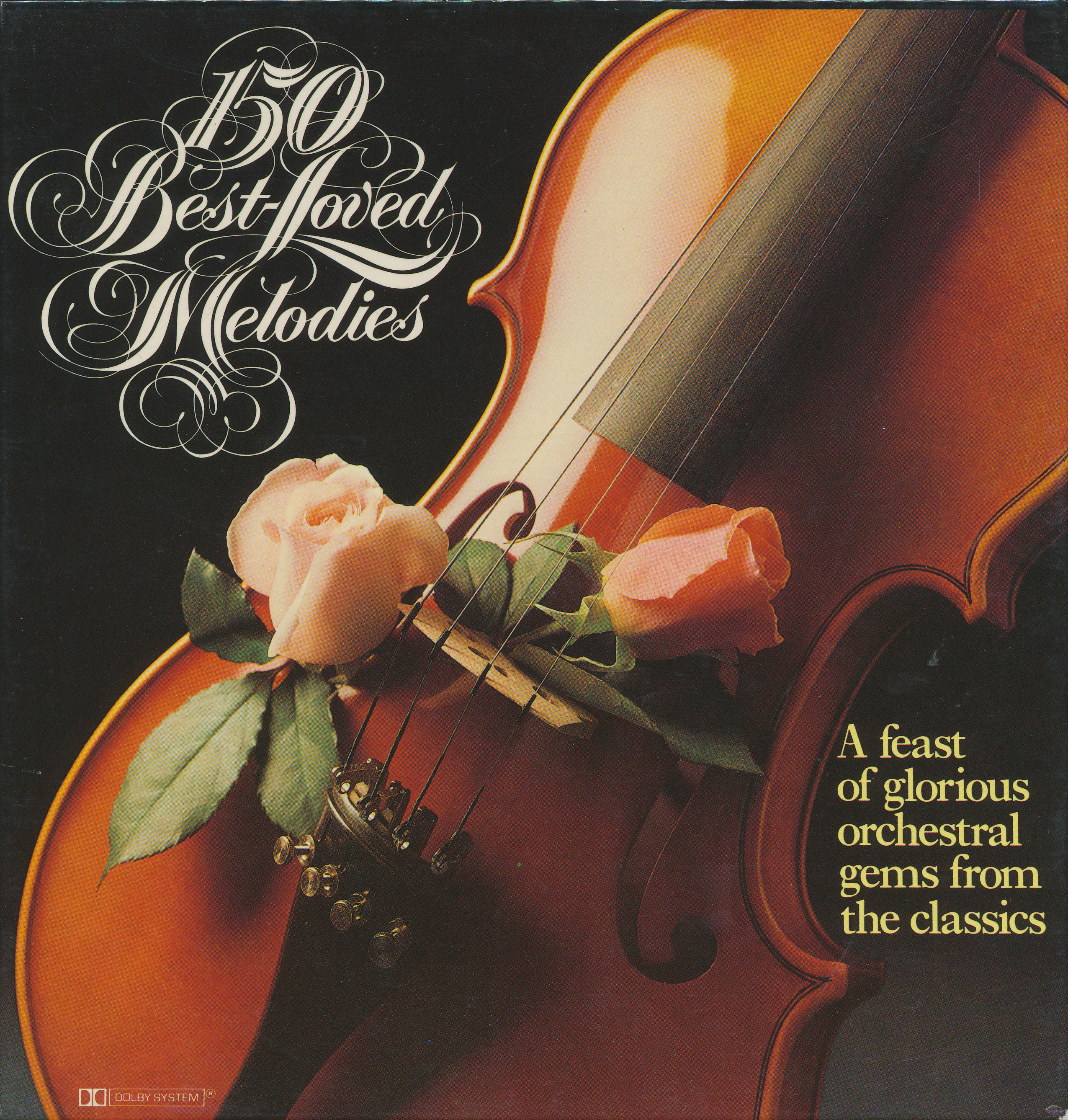
150 Best Loved Melodies

~ Parution par Various Artists (afficher toutes les versions de cette parution, 1 proposée)

Liste de pistes

1Cassette
2Cassette
noTitreArtisteÉvaluationDurée
C1On Wings of Song
orchestre :
London Promenade Orchestra (before it became known as the National Philharmonic Orchestra in ca. 1971)
conductor :
Eric Hammerstein (possibly a pseudonym used by American conductor Robert Mandell)
recording of :
Auf Flügeln des Gesanges, op. 34 Nr. 2 (catch-all for arrangements)
compositeur :
Felix Mendelssohn (composer)
arrangement de :
Auf Flügeln des Gesanges, op. 34 Nr. 2 (original for voice and piano)
Felix Mendelssohn2:48
C2The Chestnut Tree
piano :
Christian Steiner (classical pianist)
orchestre :
RCA Victor Symphony Orchestra
conductor :
Charles Gerhardt (conductor, producer, arranger)
instrumental recording of :
Myrthen, op. 25: Nr. 3. Der Nußbaum
parolier :
Julius Mosen
compositeur :
Robert Schumann (German classical composer)
partie de :
Myrthen, op. 25
Robert Schumann2:51
C3Last Spring
orchestre :
RCA Symphony Orchestra
conductor :
Eric Hammerstein (possibly a pseudonym used by American conductor Robert Mandell)
recording of :
To elegiske melodier, op. 34: No. 2. Våren (Two Elegiac Melodies, op. 34: No. 2. The Last Spring, for strings)
orchestrateur et compositeur :
Edvard Grieg (composer)
orchestration de :
To elegiske melodier, op. 34: No. 2. Våren (for piano)
partie de :
To elegiske melodier, op. 34 (Two Elegiac Melodies, op. 34, for strings)
Edvard Grieg3:26
C4The Flight of the Bumble Bee
orchestre :
New Symphony Orchestra of London (often referred to as just The New Symphony Orchestra)
conductor :
René Leibowitz (conductor)
recording of :
Полёт шмеля (Le Vol du bourdon, Flight of the Bumblebee; orchestral interlude between Tableaus 1 & 2 in Act III of The Tale of Tsar Saltan)
compositeur :
Николай Андреевич Римский‐Корсаков (Nikolaï Rimski-Korsakov, Russian composer) (du 1899 au 1900)
partie de :
The Tale of Tsar Saltan: Act III
Rimsky-Korsakov1:30
C5Dance of the Swans from 'Swan Lake'
orchestre :
London Philharmonic Orchestra (Orchestre philharmonique de Londres, LPO; The Philharmonic Promenade Orchestra)
conductor :
Massimo Freccia (conductor)
recording of :
The Swan Lake (suite from the ballet), op. 20a: III. Danse des cygnes
compositeur :
Пётр Ильич Чайковский (Piotr Ilitch Tchaïkovski, Russian romantic composer) (le 1876)
partie de :
The Swan Lake (suite from the ballet), op. 20a (Version A - 6 movements)
partie de :
The Swan Lake (suite from the ballet), op. 20a (Version B - 8 movements)
Tchaikovsky1:27
C6Flower Song from 'Carmen'
orchestre :
London Promenade Orchestra (before it became known as the National Philharmonic Orchestra in ca. 1971)
conductor :
Eric Hammerstein (possibly a pseudonym used by American conductor Robert Mandell)
instrumental recording of :
Carmen : Acte II. No. 17 Duo : « La Fleur que tu m’avais jetée » (Carmen, Don José) (Flower Song)
compositeur :
Georges Bizet (French composer) (le 1875)
librettiste :
Ludovic Halévy (French librettist) (le 1875) et Henri Meilhac (le 1875)
partie de :
Carmen : Acte II
Georges Bizet3:11
C7The Last Rose of Summer
orchestre :
Douglas Gamley and His Orchestra
instrumental recording of :
Martha: Akt II. „Letzte Rose“ (The Last Rose of Summer)
compositeur :
Friedrich von Flotow (composer)
partie de :
Martha: Akt II
Friedrich von Flotow3:46
C8Greensleeves
orchestre :
Douglas Gamley and His Orchestra
instrumental recording of :
Greensleeves (generic entry for traditional and unknown arrangements)
parolier et compositeur :
[traditional] (Traditionnel, special purpose artist)
[traditional]2:22
C9The Maid with the Flaxen Hair
orchestre :
Royal Philharmonic Orchestra
conductor :
Peter Knight (British arranger, conductor and composer)
recording of :
Préludes, Livre I, L. 117, CD 125: VIII. La fille aux cheveux de lin. Très calme et doucement expressif (The Girl with the Flaxen Hair)
compositeur :
Claude Debussy (French composer) (du 1909-12 au 1910-02)
première à :
[concert] (1910-06-02)
partie de :
Préludes, Livre I, L. 117, CD 125
Claude Debussy2:52
C10Humoresque
orchestre :
National Philharmonic Orchestra (fka the London Promenade Orchestra until 1971, mostly film music and opera)
conductor :
Eric Robinson (conductor)
recording of :
Humoresque in G-flat major, op. 101 no. 7 (catch-all for arrangements)
compositeur :
Antonín Dvořák (composer) (le 1894)
arrangement de :
Humoresque no. 7 for Piano in G-flat major, B. 187/7, op. 101 no. 7: Poco lento e grazioso (for piano)
Antonín Dvořák2:19
C11Summertime
orchestre :
New Symphony Orchestra of London (often referred to as just The New Symphony Orchestra)
conductor :
René Leibowitz (conductor)
instrumental recording of :
Summertime (American songbook standard from 1935 opera Porgy and Bess)
parolier :
Ira Gershwin (le 1934), Dorothy Heyward (playwright) (le 1934) et DuBose Heyward (le 1934)
compositeur :
George Gershwin (composer) (le 1934)
éditeur :
Chappell & Co., Chappell & Co., Inc. (USA), Chappell Music Ltd., Dubose and Dorothy Heyward Memorial Fund Publishing, George Gershwin Music, New Dawn Music, Warner Chappell Music Ltd. (no slash; used 1988–1996), Warner/Chappell (Warner/Chappell Music, Inc.), Warner/Chappell Music Holland BV, Warner/Chappell North America Limited (formerly incorporated as Marmalade Music Ltd., from 1968/09/19–1999/11/09), Ira Gershwin Music (le 1935), WB Music Corp. (1929–2019) (du 1935 au 2019-05-28) et WC Music Corp. (du 2019-05-28 à ce jour)
version de :
Porgy and Bess: Act I, Scene I. “Summertime” (Clara)
George Gershwin2:23
C12The Swan
orchestre :
The London Pops Orchestra
conductor :
Robert Mandell (American conductor)
recording of :
Le Carnaval des animaux : XIII. Le Cygne (The Carnival of the Animals: XIII. The Swan, two pianos and cello)
compositeur :
Camille Saint‐Saëns (composer) (le 1886-02)
arrangeur :
Pege Aladár
partie de :
Le Carnaval des animaux (The Carnival of the Animals, Grande fantaisie zoologique, R 125)
Camille Saint‐Saëns3:15
C13Plaisir d'Amour
orchestre :
London Promenade Orchestra (before it became known as the National Philharmonic Orchestra in ca. 1971)
conductor :
Eric Hammerstein (possibly a pseudonym used by American conductor Robert Mandell)
instrumental recording of :
Plaisir d’amour (Romance du chevrier)
parolier :
Jean-Pierre Claris de Florian
compositeur :
Jean‐Paul‐Égide Martini (Plaisir d'amour)
éditeur :
Warlock Music Ltd.
Jean‐Paul‐Égide Martini3:29
C14Air on the G String
orchestre :
London Promenade Orchestra (before it became known as the National Philharmonic Orchestra in ca. 1971)
conductor :
Eric Hammerstein (possibly a pseudonym used by American conductor Robert Mandell)
recording of :
Orchestersuite Nr. 3 D-Dur, BWV 1068: II. Air (Orchestral Suite no. 3 in D major, BWV 1068: II. Air, Air on the G string)
compositeur :
Johann Sebastian Bach (Jean‐Sébastien Bach, German Baroque period composer & musician) (le 1730)
partie de :
Orchestersuite Nr. 3 D-Dur, BWV 1068 (Orchestral Suite no. 3 in D major, BWV 1068)
Johann Sebastian Bach3:43
D1The Skaters Waltz
orchestre :
New Symphony Orchestra of London (often referred to as just The New Symphony Orchestra)
conductor :
René Leibowitz (conductor)
recording of :
Les Patineurs, op. 183 (Les patineurs, op. 183)
compositeur :
Émile Waldteufel (classical composer) (le 1882)
Émile Waldteufel2:31
D2Fast Track Polka
orchestre :
Orchester der Wiener Volksoper
conductor :
Josef Leo Gruber (conductor)
recording of :
Bahn frei!, op. 45
compositeur :
Eduard Strauss (19th century composer)
partie de :
Works of Eduard Strauss by opus number (numéro : op. 45)
Eduard Strauss2:10
D3Tales from the Vienna Woods
orchestre :
Orchester der Wiener Staatsoper (Orchestre de l’Opéra de Vienne)
conductor :
Josef Leo Gruber (conductor)
recording of :
Geschichten aus dem Wienerwald, op. 325 (Histoires de la forêt viennoise)
compositeur :
Johann Strauss (Johann Strauss II, Austro-German composer, „Walzerkönig“, Johann Strauss II, Sohn, Jr., the Younger, the Son) (le 1868)
partie de :
Works of Johann Strauss Jr. by opus number (numéro : op. 325)
Johann Strauss II2:05
D4Hungarian Dance No.5Johannes Brahms2:16
D5Schön Rosmarin
orchestre :
RCA Victor Symphony Orchestra
conductor :
Douglas Gamley (film composer)
recording of :
Schön Rosmarin (for violin and piano)
compositeur :
Fritz Kreisler (Austrian‐American violinist and composer)
partie de :
Alt-Wiener Tanzweisen (for violin and piano)
Fritz Kreisler2:03
D6Solveig's Song
orchestre :
Orchestra della RCA Italiana (established early 1960s, from the former disbanded RCA Victor Symphony Orchestra)
conductor :
René Leibowitz (conductor)
recording of :
Peer Gynt Suite no. 2, op. 55: IV. Solveigs sang (Peer Gynt Suite no. 2, op. 55: IV. Solveig’s Song, do not use if there is a singer)
compositeur :
Edvard Grieg (composer) (le 1875)
révisé par :
Edvard Grieg (composer) (le 1891)
version de :
Peer Gynt, op. 23: 4. akt: Solveigs sang
partie de :
Peer Gynt Suite no. 2, op. 55
Edvard Grieg1:45
D7Play Gypsies, Dance Gypsies from 'Countess Maritza'
orchestre :
Henri René & His Orchestra
recording of :
Gräfin Mariza: Akt I. „Komm Zigány“ (Tassilo)
compositeur :
Emmerich Kálmán (Kálmán Imre - composer)
partie de :
Gräfin Mariza: Akt I
Imre Kálmán2:31
D8The Moldau
orchestre :
New Symphony Orchestra of London (often referred to as just The New Symphony Orchestra)
conductor :
Sir Alexander Gibson (conductor)
recording of :
Má vlast: II. Vltava, JB 1:112/2 (Die Moldau)
compositeur :
Bedřich Smetana (composer) (du 1874-11-20 au 1874-12-08)
partie de :
B. number catalogue by František Bartoš (numéro : B. 111)
est basée sur :
La Mantovana
partie de :
Má vlast, JB 1:112 (My Country / My Fatherland)
Bedřich Smetana2:56
D9Slavonic Dance in C, No.7
orchestre :
National Philharmonic Orchestra (fka the London Promenade Orchestra until 1971, mostly film music and opera)
conductor :
Douglas Gamley (film composer)
recording of :
Slavonic Dances, op. 72: No. 7 in C major: Allegro vivace (for orchestra)
compositeur :
Antonín Dvořák (composer) (du 1886-11 au 1887-01-05)
première à :
[concert] (1887-01-06)
partie de :
Slawische Tänze, op. 72, B. 147 (Slavonic Dances, op. 72, B. 147, for orchestra)
Antonín Dvořák1:46
D10Czardas from 'Die Fledermaus'
orchestre :
Royal Philharmonic Orchestra
conductor :
Charles Gerhardt (conductor, producer, arranger)
instrumental recording of :
Die Fledermaus, Act II: Echoes of Hungary! (Czárdás)
parolier :
Mel Mandel (composer and lyricist) et Norman Sachs
compositeur :
Johann Strauss (Johann Strauss II, Austro-German composer, „Walzerkönig“, Johann Strauss II, Sohn, Jr., the Younger, the Son)
partie de :
Die Fledermaus (English version, lyrics by Mandel/Sachs)
Johann Strauss II2:39
D11Finlandia
orchestre :
London Festival Orchestra (“house orchestra” of Decca Records, associated since 1980 with conductor Ross Pople)
conductor :
Charles Gerhardt (conductor, producer, arranger)
recording of :
Finlandia, op. 26 (for orchestra)
première en :
Helsinki, Uusimaa, Finlande (le 1900-07-02)
compositeur :
Jean Sibelius (Finnish composer) (le 1899)
révisé par :
Jean Sibelius (Finnish composer) (le 1900)
première à :
Konsertti (1900-07-02)
éditeur :
Breitkopf & Härtel (le 1905)
partie de :
Works of Jean Sibelius by opus number (numéro : op. 26)
version de :
Sanomalehdistön päivien musiikki, op. 25/26: VII. Tableau 6. Finland Awakes
Jean Sibelius2:54
D12Triumphal March from 'Aida'
orchestre :
Orchestra Filarmonica di Roma (Freelance recording orchestra, mainly used by RCA & Reader’s Digest)
conductor :
Massimo Freccia (conductor)
recording of :
Aida: Atto II, scena 2. Gran Finale II “Gloria all’Egitto, ad Iside” (Popolo, Sacerdoti)
compositeur :
Giuseppe Verdi (Italian opera composer)
librettiste :
Antonio Ghislanzoni
partie de :
Aida: Atto II
Giuseppe Verdi3:23
D13Emperor Waltz
orchestre :
Orchester der Wiener Staatsoper (Orchestre de l’Opéra de Vienne)
conductor :
Josef Leo Gruber (conductor)
recording of :
Kaiser‐Walzer, op. 437 (Emperor Waltz, op. 437)
première en :
Berlin, Allemagne (le 1889-10-21)
compositeur :
Johann Strauss (Johann Strauss II, Austro-German composer, „Walzerkönig“, Johann Strauss II, Sohn, Jr., the Younger, the Son) (le 1889)
partie de :
Works of Johann Strauss Jr. by opus number (numéro : op. 437)
Johann Strauss II3:12
D14Military Polonaise
orchestre :
London Promenade Orchestra (before it became known as the National Philharmonic Orchestra in ca. 1971)
conductor :
Eric Hammerstein (possibly a pseudonym used by American conductor Robert Mandell)
recording of :
Polonaise in A major, op. 40 no. 1 “Military”
compositeur :
Fryderyk Chopin (Frédéric Chopin, composer) (le 1838)
partie de :
List of numbered polonaises by Fryderyk Chopin (in composition date order) (numéro : 3), Chopin: An Index of His Works in Chronological Order (The Brown Catalogue) (numéro : B. 120) et Katalog Dzieł Fryderyka Chopina (Catalogue of the Works of Frédéric Chopin, Chomiński Catalogue) (numéro : C. 152)
partie de :
Polonaises, op. 40
Fryderyk Chopin3:00
D15Largo from 'Xerxes'
orchestre :
National Philharmonic Orchestra (fka the London Promenade Orchestra until 1971, mostly film music and opera)
conductor :
Eric Robinson (conductor)
instrumental recording of :
Serse, HWV 40: Atto I. Arioso “Ombra mai fù” (“largo”; catch‐all for arrangements)
compositeur :
George Frideric Handel (Georg Haendel, German‐British baroque composer)
arrangement de :
Serse, HWV 40: Atto I, no. 2. Arioso “Ombra mai fù” (Serse)
George Frideric Handel3:47
D16Hornpipe from 'Water Music Suite No.2'
orchestre :
Orchestra dell’Accademia Nazionale di Santa Cecilia (Orchestra of the National Academy of Santa Cecilia)
conductor :
Arturo Basile (Italian opera conductor)
recording of :
Water Music, Suite no. 2 in D major, HWV 349: 12. Alla hornpipe
compositeur :
George Frideric Handel (Georg Haendel, German‐British baroque composer) (le 1717)
partie de :
Water Music Suite no. 2 in D major, HWV 349
George Frideric Handel1:20
3Cassette
4Cassette
5Cassette